How Agentic AI and Generative AI Are Quietly Transforming Global Industries?
Let’s be honest. A few years ago, most people outside the tech industry had never heard the phrase “generative AI.” Today, it’s everywhere in boardrooms, hospital corridors, factory floors, and school classrooms. And right behind it comes something even more significant: agentic AI. Not just a tool that responds to you, but one that actually goes out and does things on your behalf.
This isn’t hype. This is already happening, across industries, across continents. And it’s worth understanding what’s really going on.
First, Let’s Separate the Two
People often use “generative AI” and “agentic AI” interchangeably. They shouldn’t.
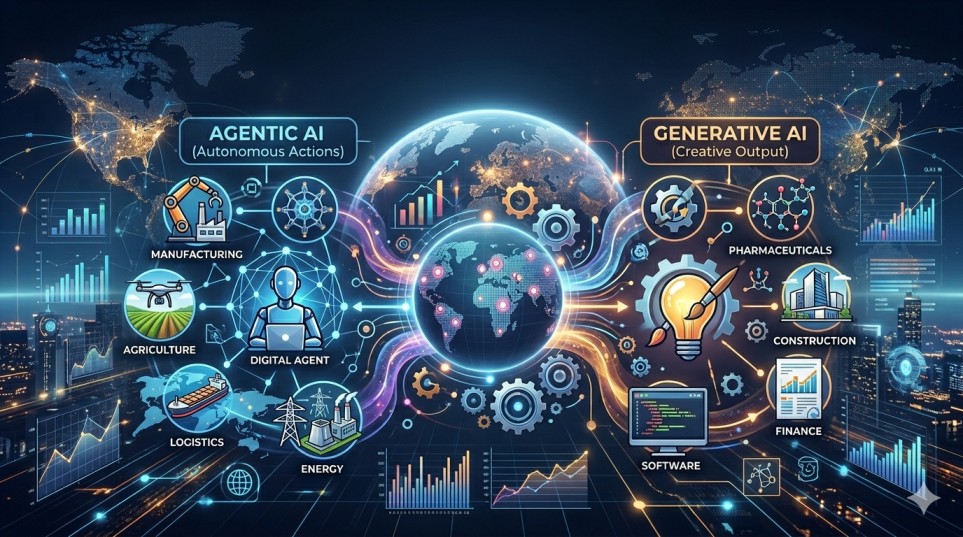
Generative AI creates things — text, images, code, video, audio. You give it a prompt, it gives you an output. It’s reactive. It waits for you to ask. ChatGPT writing a report, Midjourney producing a visual concept, GitHub Copilot suggesting a block of code — these are all generative AI at work.
Agentic AI is a different beast altogether. It doesn’t wait. You give it a goal — not a prompt, a goal — and it figures out the steps, uses tools, makes decisions, and executes. It can browse the web, send emails, write and run code, pull data from multiple sources, and loop back to check its own work.
The real power? When you combine both. Generative AI handles the creative and analytical output. Agentic AI handles the execution. Together, they’re reshaping how entire industries operate.
Healthcare: AI That Actually Saves Time (and Lives)
Talk to any doctor and they’ll tell you — paperwork is killing them. Not metaphorically. The administrative burden in healthcare has become genuinely unsustainable. Generative AI is starting to fix that. It summarizes patient histories, drafts clinical notes during consultations, and flags gaps in documentation before a chart is ever submitted.
But the bigger story is in drug discovery. Traditionally, developing a new drug takes over a decade and costs billions. Agentic AI systems are now autonomously running through molecular simulations, testing hypotheses, eliminating dead ends, and surfacing promising compounds — without a researcher having to direct every single step. Companies like Insilico Medicine have demonstrated that AI-driven pipelines can bring a drug candidate from concept to early clinical trials in a fraction of the usual time.
Finance: From Automation to Autonomous Decision-Making
Banks have been using automation for decades. But what’s happening now is different in kind, not just degree.
Generative AI is producing market research reports, writing regulatory filings, and handling customer service conversations that used to require trained human agents. It’s fast, consistent, and available around the clock.
Agentic AI, though, is where things get genuinely disruptive. Trading algorithms that don’t just follow rules but adapt to new conditions in real time. Fraud detection agents that don’t wait for a human analyst to review a suspicious transaction — they investigate it, cross-reference it against behavioral patterns, and act on it in milliseconds. Portfolio management systems that rebalance holdings autonomously based on shifting risk signals.
Financial institutions that are ahead of this curve aren’t just saving costs. They’re building capabilities their slower competitors simply don’t have.
Manufacturing: The Factory That Manages Itself
In manufacturing, downtime is money. Every hour a machine sits idle because of an unexpected failure is revenue lost. Generative AI is helping engineers design products faster — describe what you need, and the system generates multiple viable design concepts in minutes. What used to take a week of CAD work can now take an afternoon.
Agentic AI is handling the operational side. Monitoring equipment in real time, predicting failures before they happen, and automatically scheduling maintenance — without anyone having to review a report first. In supply chains, agents are tracking inventory, detecting disruptions, and rerouting shipments without waiting for a logistics manager to notice the problem.
Companies like Siemens and BMW aren’t piloting this quietly in a corner lab. They’re integrating it into core operations.
Education: Finally, Learning That Adapts to the Student
Here’s something teachers have known for years: one-size-fits-all education doesn’t work. Different students learn at different speeds, in different ways, with different gaps in their understanding. The problem was always that truly personalized instruction required resources most schools couldn’t afford.
Generative AI is helping teachers build customized lesson materials, generate practice exercises at different difficulty levels, and give students instant, detailed feedback on their writing. Agentic AI is going further — tracking each student’s progress over time, identifying exactly where they’re struggling, and adjusting what content gets served to them next. No waiting for a quarterly assessment. The adaptation happens continuously.
This isn’t replacing teachers. It’s giving them leverage they’ve never had before.
Retail: Knowing What You Want Before You Do
Generative AI produces product descriptions, ad copy, and personalized marketing messages at a scale that would have required enormous creative teams just five years ago. Agentic AI powers shopping assistants that understand individual customer preferences, browse available products, compare options, and make tailored recommendations — or even complete routine purchases automatically.
Behind the scenes, the same technology is managing inventory replenishment, adjusting pricing dynamically, and optimizing logistics. The result is a retail operation that is leaner, faster, and more responsive than anything that came before.
So Where Does This Leave Us?
It’s tempting to frame all of this as either utopian or alarming. Neither is quite right.
What’s actually happening is more nuanced. Industries are discovering that a small team of people directing intelligent AI agents can accomplish what previously required large departments. That changes workforce dynamics, yes. It raises real questions about accountability, oversight, and who benefits from the efficiency gains.
But it also opens up possibilities that didn’t exist before. Medicines developed faster. Financial risks caught earlier. Students who get the individualized attention they deserve. Factories that don’t shut down unexpectedly.
The organizations figuring this out aren’t waiting for the technology to mature further. They’re learning by doing, building internal expertise, and moving quickly. The ones still debating whether AI is “ready” may find, in a few years, that the window for catching up has quietly closed.
Generative and agentic AI aren’t the future of industry. For a growing number of companies worldwide, they’re already the present.